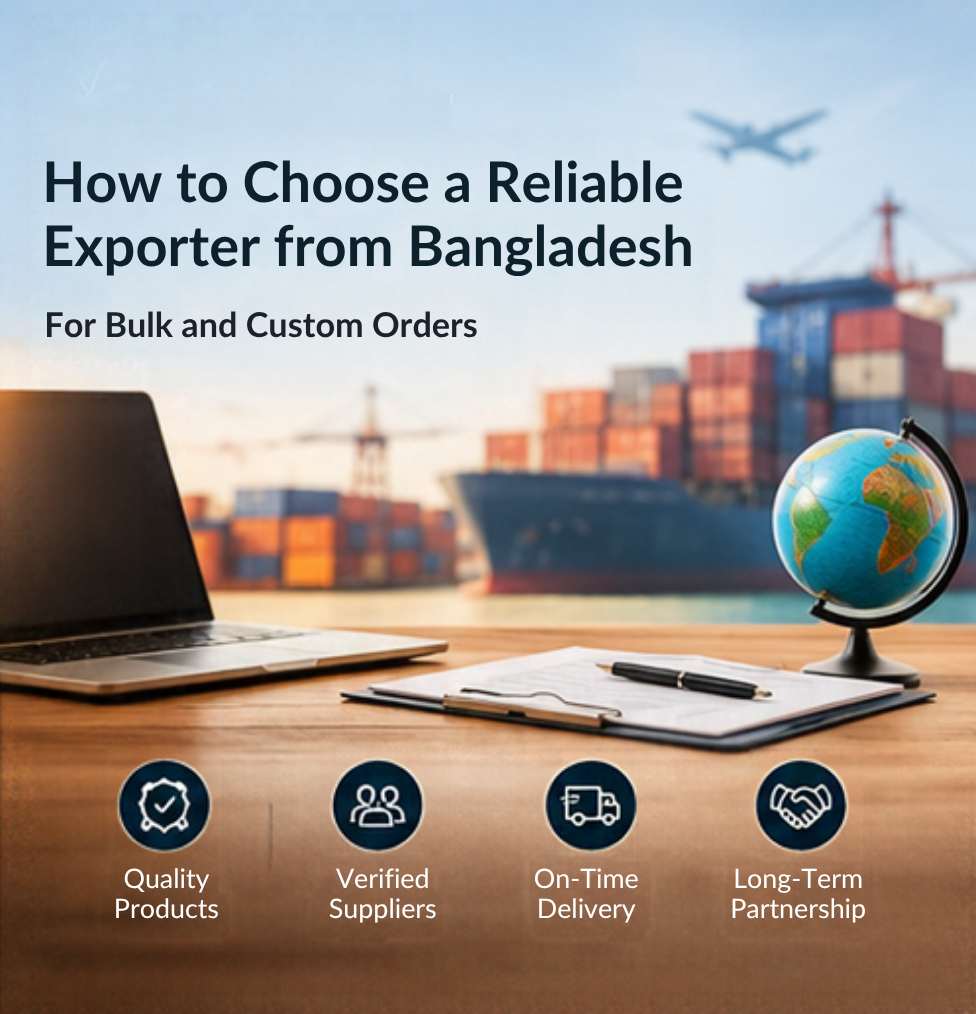
How to Choose a Reliable Exporter from Bangladesh for Bulk and Custom Orders
Learn how to evaluate Bangladeshi exporters, compare quotations, check product quality, and manage bulk orders for international trade.
Choosing the right exporter is an important decision for
international businesses.
A supplier may offer attractive prices, but long-term
success also depends on product quality, clear communication, realistic
production schedules, accurate documentation, and dependable shipment
coordination.
For importers, wholesalers, retailers, and brand owners
sourcing from Bangladesh, evaluating these factors before placing an order can
help reduce commercial risks.
This guide explains what to consider when selecting an
export partner.
1. Check the Supplier's Product Expertise
Start by identifying suppliers who understand your required
product category.
Bangladesh has suppliers working across multiple industries,
including:
- Jute
and natural-fiber products
- Handmade
handicrafts
- Bags
and promotional merchandise
- Home
décor and lifestyle accessories
- Bamboo
and cane products
- Selected
leather goods
- Textile
and related products
A supplier's experience with one category does not
automatically establish expertise in another.
Ask for relevant product photographs, specifications,
samples, and information about manufacturing or sourcing capabilities.
For customized products, discuss whether the supplier can
work from your design, reference sample, dimensions, and material requirements.
2. Verify Business Information
Before making a financial commitment, review the supplier's
available business information.
Depending on the transaction, useful checks may include:
- Registered
business details
- Business
address and contact information
- Relevant
trade or export registrations
- References
or previous transaction evidence
- Product
and production capabilities
- Banking
and payment information
- Relevant
certifications, if claimed
Where appropriate, independently verify important details
and consider a factory visit or third-party inspection.
The level of verification should reflect the order value,
product complexity, and commercial risk.
3. Request a Detailed Quotation
A professional quotation should make it clear what you are
buying and what the quoted price covers.
Ask the exporter to specify:
- Product
name and description
- Material
composition
- Dimensions
and other specifications
- Unit
price and currency
- Minimum
order quantity
- Customization
charges
- Packaging
costs
- Sample
charges, if applicable
- Production
lead time
- Quotation
validity
- Payment
terms
- Shipping
terms
- Any
excluded costs
When comparing quotations, make sure the products and trade
terms are equivalent.
A lower unit price may not represent the lowest total cost
if it excludes packaging, customization, freight, or other necessary services.
4. Approve Samples Before Bulk Production
Samples are particularly important for handmade, customized,
and design-sensitive products.
A sample can help you evaluate:
- Material
quality
- Workmanship
- Dimensions
- Color
and finishing
- Structural
strength
- Functionality
- Branding
and printing
- Packaging
presentation
Document the approved sample and the final specifications.
For repeat orders, retain a reference sample or agreed
quality standard when practical.
This helps both parties understand the expected result and
reduces the possibility of disagreements.
5. Establish Clear Quality-Control Procedures
Quality requirements should be agreed upon before production
begins.
Depending on the product, inspections may cover:
- Raw
materials
- Workmanship
- Dimensions
and tolerances
- Color
consistency
- Stitching
and finishing
- Functional
performance
- Branding
accuracy
- Packaging
- Carton
quantities
For larger orders, buyers may arrange inspections during
production and before shipment.
If the goods must meet particular destination-market
standards, communicate those requirements in writing and agree on how
compliance will be demonstrated.
6. Evaluate Production Capacity and Lead Times
An exporter should provide realistic information about
production and delivery schedules.
Ask about:
- Current
production capacity
- Material
availability
- Sample
approval deadlines
- Estimated
production duration
- Peak-season
constraints
- Packaging
and inspection time
- Shipping
arrangements
Remember that production lead time and total delivery time
are not the same.
International delivery may also involve inland
transportation, export clearance, freight transit, destination customs
clearance, and final delivery.
Plan inventory and sales commitments using the complete
estimated timeline rather than production time alone.
7. Understand Payment and Shipping Terms
Before transferring money, confirm the payment arrangement
and the responsibilities of each party.
Your agreement should clearly identify:
- The
contracting parties
- Total
order value
- Payment
milestones
- Production
obligations
- Shipping
responsibilities
- Applicable
trade terms
- Required
documents
- Procedures
for resolving discrepancies
For international shipments, terms such as EXW, FOB, CIF,
and DAP allocate different responsibilities and costs.
The exact obligations depend on the agreed Incoterm and
named place or port. Buyers should ensure that the quotation and contract
clearly specify both.
Use appropriate commercial safeguards for the transaction,
particularly when dealing with a new supplier or a substantial order.
8. Confirm Export Documentation Requirements
Export and import documentation varies according to the
goods, destination, shipment method, and applicable regulations.
Depending on the transaction, documents may include:
- Commercial
invoice
- Packing
list
- Transport
document
- Certificate
of origin, where required
- Export
and import declarations
- Product-specific
certificates or permits
Some goods made from natural materials may require
additional checks or documentation.
Before shipment, confirm the requirements with the exporter,
freight forwarder, customs broker, and relevant authorities.
Accurate documentation can help prevent avoidable customs
delays and unexpected costs.
9. Evaluate Communication and Long-Term Support
Good communication is essential when sourcing products
internationally.
A dependable export partner should be able to explain
product specifications, clarify quotation details, respond to reasonable
questions, and communicate changes that may affect the order.
Before committing to a long-term arrangement, assess whether
the supplier understands your requirements and provides clear, consistent
information.
For repeat business, discuss how future orders, design
changes, quality issues, and delivery schedules will be managed.
Why Consider Miti’s Mart as Your Bangladesh Export
Partner?
Miti’s Mart works with international buyers seeking products
from Bangladesh, including jute bags, handmade handicrafts, natural-fiber
products, home décor, lifestyle accessories, and leather goods.
Our export service focuses on supporting buyers through
product inquiries, customization discussions, quality checks, packaging
requirements, documentation coordination, and shipping arrangements according
to the agreed order.
We understand that each business has different needs. A
retailer ordering a small assortment of home accessories may have different
requirements from a distributor purchasing large quantities of customized bags.
For this reason, we encourage buyers to share their product
specifications, intended market, order quantity, target price, and preferred
delivery arrangements when making an inquiry.
Conclusion
Selecting a reliable exporter requires more than comparing
prices.
Product expertise, supplier verification, approved samples,
clear specifications, quality control, transparent payment terms, and realistic
delivery schedules all contribute to a stronger sourcing relationship.
Taking time to evaluate these factors can help importers
make better purchasing decisions and build sustainable long-term business
partnerships.
Looking for a Bangladesh exporter for bulk or customized
products?
Visit Miti’s Mart to explore our product range, or contact us through our Export Service page to discuss your requirements.
Recent Posts