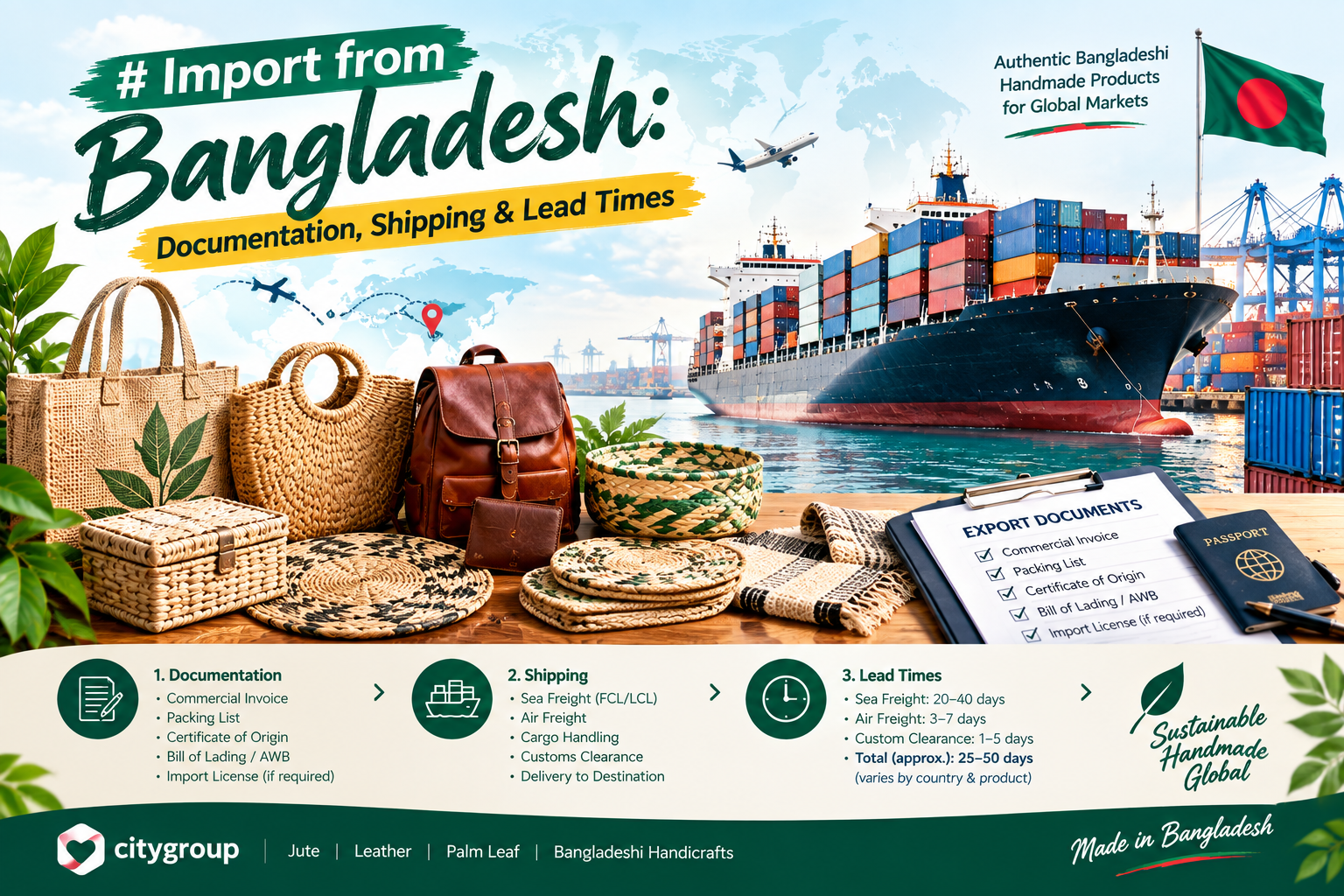
Import from Bangladesh: Documentation, Shipping & Lead Times
A practical guide to importing from Bangladesh in 2026 — required export documents, realistic lead times, shipping routes, and how to avoid customs delays.
Import from Bangladesh: Documentation, Shipping, and Lead Times Explained
For international buyers new to sourcing from Bangladesh, the biggest risks rarely come from product quality — they come from paperwork gaps, shipping delays, and unrealistic timeline expectations. Understanding how the process actually works, before you place your first order, saves both money and time.
Here is a practical, plain-English breakdown of what to expect.
The Documents Your Supplier Needs
Every legitimate export shipment from Bangladesh depends on a specific set of documents. As a buyer, knowing these exist — and asking to see them — protects you from working with unreliable suppliers.
Export Registration Certificate (ERC). This is the legal license every Bangladeshi exporter must hold, issued by the Office of the Chief Controller of Imports and Exports under the Ministry of Commerce. A valid ERC number must appear on every commercial invoice, and customs verifies it during clearance. For certain products — including jute and jute goods — the ERC carries additional product-specific conditions. If a supplier can't produce a valid ERC, that's a serious red flag.
Commercial Invoice. Must include the ERC number, HS code, agreed pricing, and full shipment details. Errors here are one of the most common causes of customs delays.
Packing List. Details exactly what's in each carton or container — critical for customs inspection and for your own receiving process.
EXP Form. Certified by the exporter's bank (Authorized Dealer), this form is required for foreign exchange control purposes on every export shipment.
Bill of Export / Bill of Lading. Filed with customs and issued by the shipping line, this is your proof of shipment and the document your bank will need if you're operating under a Letter of Credit.
Certificate of Origin. Often required by your country's customs authority to determine duty rates, and essential if you intend to claim any preferential tariff treatment.
Insurance Certificate. Not always mandatory, but its absence can leave both parties exposed if goods are damaged or lost in transit.
A missing or incorrect document doesn't just cause paperwork headaches — it can hold your container at Chattogram Port for days, and if you're on a Letter of Credit, that delay can put the entire payment at risk.
Realistic Lead Times
One of the most common mistakes new buyers make is underestimating how long production genuinely takes. Bangladesh manufacturing typically requires 60 to 120 days from order placement to shipment, depending on product complexity, order volume, and seasonal factory load. Simpler products with available raw materials sit toward the shorter end; complex, custom, or high-volume orders sit toward the longer end.
Build this into your planning from day one. Suppliers who promise dramatically shorter timelines than this range are often either underestimating their own capacity or setting expectations they won't meet.
Shipping: What's Changed in 2026
Shipping conditions out of Bangladesh have tightened this year. Freight rates have risen sharply — costs to some destinations have more than doubled compared to a few months earlier — and lead times on ocean freight have increased by up to three weeks in some cases, as shipping lines have reduced container bookings from Bangladeshi ports.
Two structural factors are worth understanding:
Port capacity is shifting. Chattogram remains the primary export port, but the Matarbari Deep Sea Port is a major infrastructure project intended to reduce Bangladesh's dependence on regional transshipment hubs and stabilize shipping costs over the coming years.
LDC graduation is approaching. Bangladesh is set to graduate from Least Developed Country status in November 2026 — a milestone that will gradually change trade preference arrangements with markets like the EU. Buyers with long-term sourcing plans should track how this affects duty treatment for their specific product categories.
Practical takeaway: build buffer time into your shipping schedule beyond quoted transit times, and confirm current freight rates before finalizing landed cost calculations — rates that were accurate three months ago may no longer hold today.
How to Reduce Risk as a Buyer
Verify the ERC and export history before ordering. A supplier with a clean, established export track record is lower risk than one who can't show prior shipment documentation.
Request document copies early, not at shipment time. Reviewing the commercial invoice and packing list draft before goods are packed gives you a chance to catch errors while they're still cheap to fix.
Build lead time buffers into your own commitments. If your customer-facing deadline requires goods to arrive by a fixed date, order well ahead of the 60–120 day production window plus current shipping delays.
Work with a supplier who manages logistics end-to-end. A partner who coordinates documentation, freight booking, and customs clearance directly removes a significant point of failure from your supply chain.
Working With Miti's Mart
We handle the documentation, compliance, and shipping coordination for every order, so our international buyers can focus on their own business rather than chasing paperwork across two countries. If you're evaluating Bangladesh as a sourcing destination — whether for jute, leather, handloom, or décor products — we're happy to walk you through exactly what a shipment timeline would look like for your specific order.
Recent Posts